Tuesday, October 2, 2012

Problem of Alternator Locking Pin

Since beginning of 2012, we are facing problem of failure of Alternator pin and its stopper ( Locking plate).

 Worn our locking plate and the pin shown above .
 Placement in bogie shown above. Welding of the plate may be noted by MTN staff.

The new stopper ( Locking plate shown above)

Monday, September 10, 2012

Emergency Light

For all coaches being sent for POH, connection should be opened from connector shown above. This is needed to save 12 VA battery from draining.

Tuesday, August 21, 2012

100 VA Mobile/laptop charging point failure in train 12138 yesterday


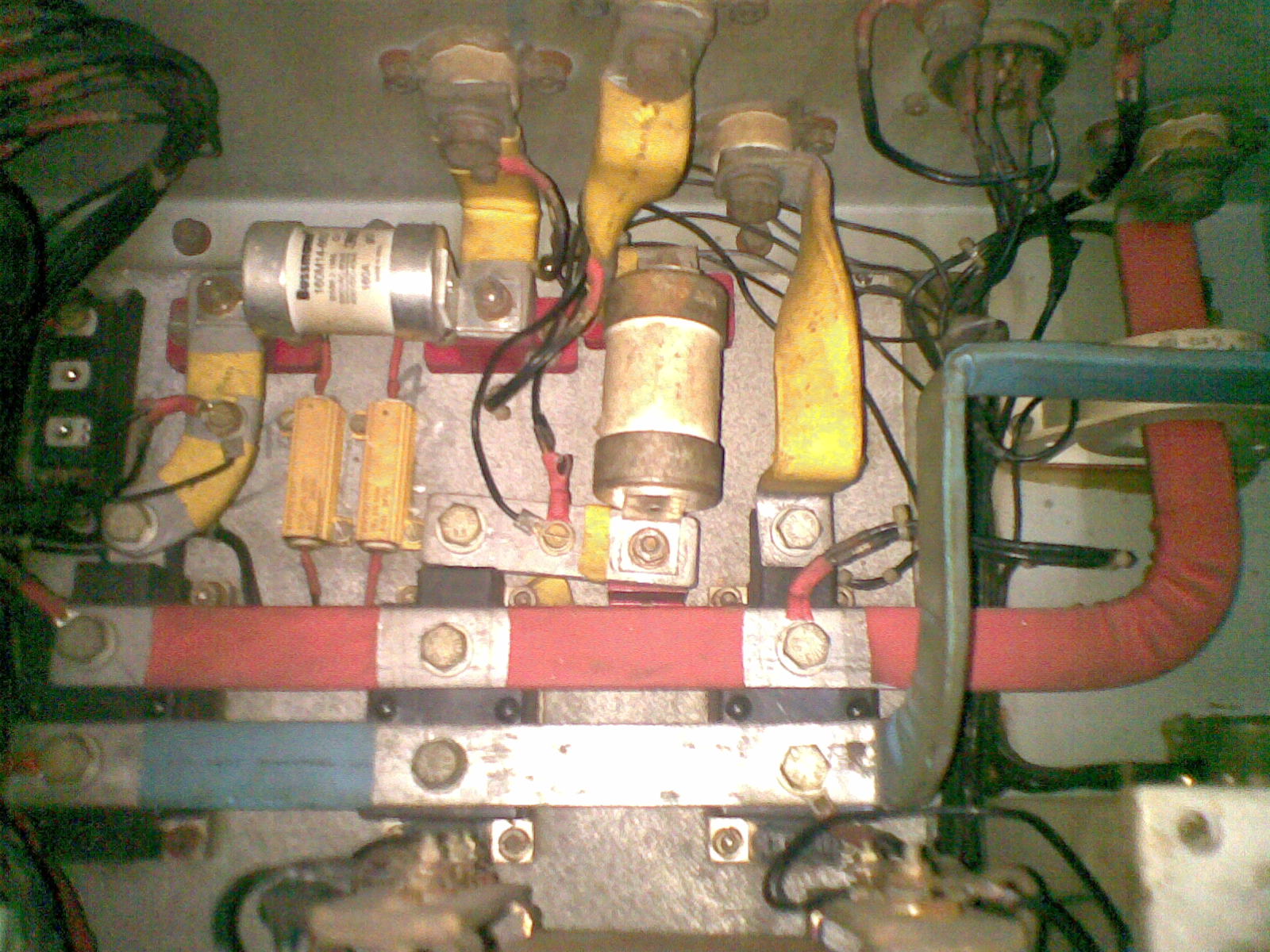
 Train was detained in BPL division for 32 minutes as S4 coach( CN11269) ICE make (SrNo110612516) failed. Smoke came out of the inverter.
Two of the three capacitors appear failed (top protruded), which might have caused bursting of fuses.
From front, the inverter appears socket appears normal.
This inverter is protected by 2 Amps glass fuse and the 35 swg (16A) wire fuse in side wall FDB.
This equipment is manufactured with spec RDSO/PE/SPEC/TL/0142-2010 (Rev-0). Having 2 years warranty from date of commissioning.
Makes in the system are: ICE,Signotron,Saranya, and HYTech.
Other System of Mobile Charging points are:
  • 2.5 KVA inverter for entire coach and then 18 sockets.(spec RDSO PE/SPEC/TL/0131-2009 (Rev-0)
  • Since chargers work on 110 V dc also, just provide 110 V dc socket (with 0.5 amps fuse) from fan supply.(spec RDSO PE/SPEC/TL/-0165-2011)(rev-0)


Thursday, August 16, 2012

500 KVA alternator repair

Corroded stampings. Staggering required we came to know pretty late.
Rotor and stator exciter.
It will need balancing lateron.

Friday, July 27, 2012

16 Point Programme

1. CESEs of the Railways to interact with their counter parts in other Railways to advise the unusual occurrences and obtain feed back .

2. All AC coaches to be pre-cooled before placement of rakes on platform. This is the time when passengers require maximum and immediate comfort levels.

3. No train to leave the PM depot with EFTs or equipment in isolated condition.

4. Defects in the coaches to be reported by escorting staff immediately after arrival of train at SM depot and remedial action taken. Escorting staff should sign the register with depot and depot staff to sign the logbook with escorting staff.

5.Ac coaches from PM depot should go with both alternators working. At SM depot, if one defective alternator cannot be repaired/replaced. Decision to send the coach with one alternator to be taken at officer's level. Second alternator to be fully functional and coach /rake to be properly pre cooled.

6. Ac coaches should go from PM depot with 6+6 belts on alternator send minimum 5+5 belts from SM depot Adequate facilities to be built up for changing belts on rake itself.

7 The knowledge of ACCI's and ACCAs should be checked regularly regarding operation of AC equipments as well as handling of situation in case of failure of equipment ACCIs/ACCAs must maintain the logbook and enter all unusual occurrences. Training of AC staff for one week duration to be standardized by the Railways.

8. Drive system for generation testing and regulator setting to be introduced for alternators at all PM depots.

9. Unit Exchange spare (USE) should be available at all depots. Each depot should have authorized, holding of USE. Register should be available for each major USE at all depots.

10. All major depots should carry out failure analysis of major equipments and information should be sent to RDSO periodically.

11. The power supply for pre-cooling to be augmented in view of increasing number of AC coaches in the depots Railways to examine and take corrective action.

12. Railways to revise their EAC Estimated annual Consumption) of material in view of increase of AC coach holding.

13. Cleaning of alternator field & phase wires to be properly checked at PM depot.

14. Full load and no load voltage of each cell of SMF batteries to be recorded (weed out weak cells) for 3months and if there is no abnormal variation of voltage there after it should be recorded once in 3 months.

15. Working of thermostat should be monitored & recorded in log book. If thermostat is not working it should be attended/replaced at PM depot.

16. Working of WRA should be checked on arrival of train at PM/SM depot and it's working should be ensured before placement of rake on platform.

Changing compressors departmentally

Two of our staff, Maruti Kamble and Raju Lohar changed defective maneurope compressors with scroll compressors.

AC fan Inverter

Location: underslung
Connection for DC input and AC output. Cables are non-interchangeable for good.
Circuit inside the coach.


Inverter inside out.

Some problems that need C&W coordination

Drain pipe just over electrical junction box. Though some coaches have been provided with added pipes, some are still to be attended.
Roofing sheet over RMPU duct. This item is procured by C&W in RCF and POH shop. But maintenance is a grey area.

Wednesday, April 6, 2011

Battery Maintenance Seminar By M/S Amar Raja


On Dt. 29.03.2011 staff training seminar was arranged at BDTS Depot about correct maintenance practices of VRLA Batteries. It was conducted by M/S AMAR RAJA. About 55 Nos. of staff attended this interactive training session and clarified their doubts and problems. Maintenance supervisors also discussed their battery failures. Following points are noted: a) It is advised that vent plug of the cell should be cleaned regularly. b) RRU / ERRU should have the voltage sating 128.5 Volt. c) Cell terminal connections should be checked for 11Nm once in 03 Months. d) Physical examination in every trip for any type of leakages. Cell should not be allowed in same condition. e) Cell voltage Meter should be calibrated at least once in a year. f) Individual cell less then 1.75 Volt should not be allowed. g) PL – Shop : POHed coach, Battery Sets should be charged for 72Hrs. and discharged for 10Hrs. @ of 10% of rated AH. This cycle must be done Twice before putting the battery set in POHed Coach.

Electronic Ballast

Following types of 110 V DC are in use in coaches:-

  • 11 W AC/DC ( for CFL in TL Coaches )

  • 20 W DC ( for Tubelights in TL Coaches )

  • 18 W AC/DC ( for LHB tubelights )

  • 11 W DC and 20 W DC ( for SGAC AC coaches )

Quite a lot inventory to manage ! and failures are still there e.g Fuse Blown, Power Transistor failure, Power Diode failure,Electrolytic condensor burst, and Zener diode failure.

Friday, March 25, 2011

Dangerous Drilling in LHB Coaches


Recently we came across the root cause of Mini-Pantry supply failures. The drill damage shown in above 2.5 sq.mm E-beam cable came as shock ! These are the cables that feed deep-freezer, hotcase and bottle coolers of Min-Pantries.
What happens is that these cables are running behind the wall panels of LHB coaches. Now for fixing the hooks, mechanical department drills into wall, unaware of the 230 V live cables running behind the wall !
Quite often, the drill damages PVC conduits and the cables as shown above. This is dangerous as damage to 230 V cables just inside the passenger coach can lead to fire also.


Wednesday, March 23, 2011

Problem of LHB Microprocessors

There are 4 makes of microprocessor in LHB RMPUs. All have different circuit designs. Now the problem is that being high value item, we can't make them stock items and being different generic designs, we can't make some parts as stock. Now when any of the part fails we generate non-stock demand and then coach runs with microprocessor bypassed till procurement.
Most of the time, we find staff not so skilled to find out which card, IC or PCb has beome defective in the microprocessor.
Any solutions?

Wednesday, March 9, 2011

New Duronto Rakes Commissioned

RCF make coaches and power cars and pantry cars of New BCT-IND and BCT-JP have been commissioned in the BCT depot. Follwoing are the lessons learnt:-
  • M/S Amit make RMPU gave lot of trouble.
  • Engines of M/S Greaves Cotton are still being attended.
  • Bill of material, Vendor List and Manuals are awaited from RCF.
Major problems encountered are as follows:-
  • Large gap between radiator side louvres in power car body make all the dust come inside the enegine room.
Engine inlet air and silencer air ducts are so badly placed that you cant dismantle the ventilation fan without first removing these ducts. As a result the vent fan replacement work which was just 30 minutes job now needs complete day.

Pump is located at such a place that dirt CDTS water and wash basin water falls upon it while on run.

Inferior quality inter-tank connecting pipe and valves have been provided. These pipes and valves dont last even a week.


Water filling cap in west side of power cars are too close to the 60KVA transformers.
As a result, transformers get drenched while water filling.

Wednesday, October 13, 2010

Glimpses of Jagadhri Workshop, Yamunanagar, Northern Railway

Recently a joint team of BCT divsion and Parel workshop supervisors visited Jagadhri to do comparative study of the two workshop. The visit was an eye opener for the team. It appears that Parel needs a complete revamp to come upto the level of Jagadhri.
Slideshow is on the right.

Monday, August 30, 2010

Endless inventry in electrical coaching , whats the remedy?


Inventry management is becoming more and more difficult in electrical coaching with time. Just have a look:-
  • Fans:- 6 types.
  • Lights:- 13 types.
  • Alternator:- 3 Types.
  • AC plants:- 4 Types , with different non-interchangeable parts inside each of these.
  • Batteries:- 7 Types.
  • Battery Chargers:- 4 Types
  • Rectifier/Regulator Unit:- 2 Types.
Among all these types, different makes have different designs. Result- difficulty in inventry management.
BCT division is tackling this issue two ways:-
1.Suggesting RCF to stick to same generic design for all makes.
2.Stocking of the equipments. ( In last 3 years more than 50 equipments have been stocked).

Wednesday, August 11, 2010

Era of open type compressors coming back?


After horrible experience with sealed type compressors ( FRPCPY >15) in AC systems, we now see latest coaches being rolled out by RCF with open type compressors.
These new coaches are having RMPUs fitted with HOB make open cimpressors which are basically inspired by DMRC experience.

Friday, July 30, 2010

Mumbai Division's first WIND TURBINE inaugurated

"वायु -शक्ति ", the first wind turbine of BCT was inaugurated by Sh. Girish Pillai, DRM -BCT on 30th July 2010.

Installed on the rooftop of power-car building, this wind turbine is of 650 W and charges the coach batteries besides supplying the shop floor lighting load.

Supplied by M/S ARCO, this wind turbine could not have been successfully installed without efforts of Sh.Anand, Section Engineer.